
Methane leak detection is a critical task for natural gas valve stations, regulating stations, metering stations, compressor stations, LNG/CNG facilities, and city gas networks.
Methane is colorless and difficult to detect by human senses. In the early stage of a leak, it may not be visible or noticeable on site. However, once methane accumulates in a local area, it can create safety risks, energy loss, and emission concerns.
For natural gas applications, methane leak detection is not only about answering the question:
“Is there a leak?”
More practical questions often include:
Where is the leak point?
Is it a methane leak?
What is the methane concentration?
Does it require immediate repair?
Has the site returned to normal after maintenance?
Different detection technologies answer different questions. OGI, acoustic cameras, and TDLAS are suited for different application scenarios. Understanding these differences helps operators choose the right tool for the job.
OGI, or Optical Gas Imaging, is mainly used to visualize gas plumes such as methane. Its key advantage is that it makes invisible gas emissions visible, allowing inspectors to see whether gas is being released from a certain area, device, valve, or pipeline.
OGI has clear value in emission inspections, LDAR programs, environmental reporting, and large-area screening.
OGI is suitable when the inspection goal is to understand:
Whether methane is being emitted;
Whether the gas plume is visible;
Which general area the gas is dispersing from;
Whether visual emission records are needed.
However, OGI shows the gas plume, not the leak hole itself.
Methane plumes can be affected by wind speed, wind direction, background temperature, viewing angle, equipment layout, and gas diffusion. The gas shown in the image may have already drifted away from the actual leak point.
Therefore, OGI is better at answering:
“Where is the methane plume?”
But for maintenance teams, this is not always enough. What needs to be repaired is the specific valve, flange, fitting, seal, connector, or leak hole.
An acoustic camera works differently.
When pressurized methane escapes through a small opening, such as valve packing, flange sealing surfaces, threaded fittings, instrument ports, pressure gauge connections, welds, seals, or connectors, the high-speed gas flow creates turbulence. This turbulence generates ultrasonic signals that are usually beyond the range of human hearing.
An acoustic camera uses a microphone array to detect these ultrasonic signals and overlays the sound source location on a visible image. It does not depend on whether the gas plume is clearly visible. Instead, it looks for the sound generated by the leak source.
Therefore, an acoustic camera is better at answering:
“Where is the leak coming from?”
In natural gas valve stations, regulating stations, metering stations, and compressor stations, many methane leaks occur at small components in pressurized systems, such as:
Valve packing
Flange connections
Regulator interfaces
Filter connections
Pressure gauge ports
Instrument fittings
Vent pipe connections
Threaded joints
Hoses and quick connectors
Pipelines around compressors
These leak holes may be small, but as long as there is a pressure difference, they may generate detectable ultrasonic signals. Acoustic imaging helps inspectors quickly locate the specific leak point within complex equipment, reducing the time required for point-by-point troubleshooting.
For maintenance work, this is highly valuable. Repair can only begin when the leak hole is found.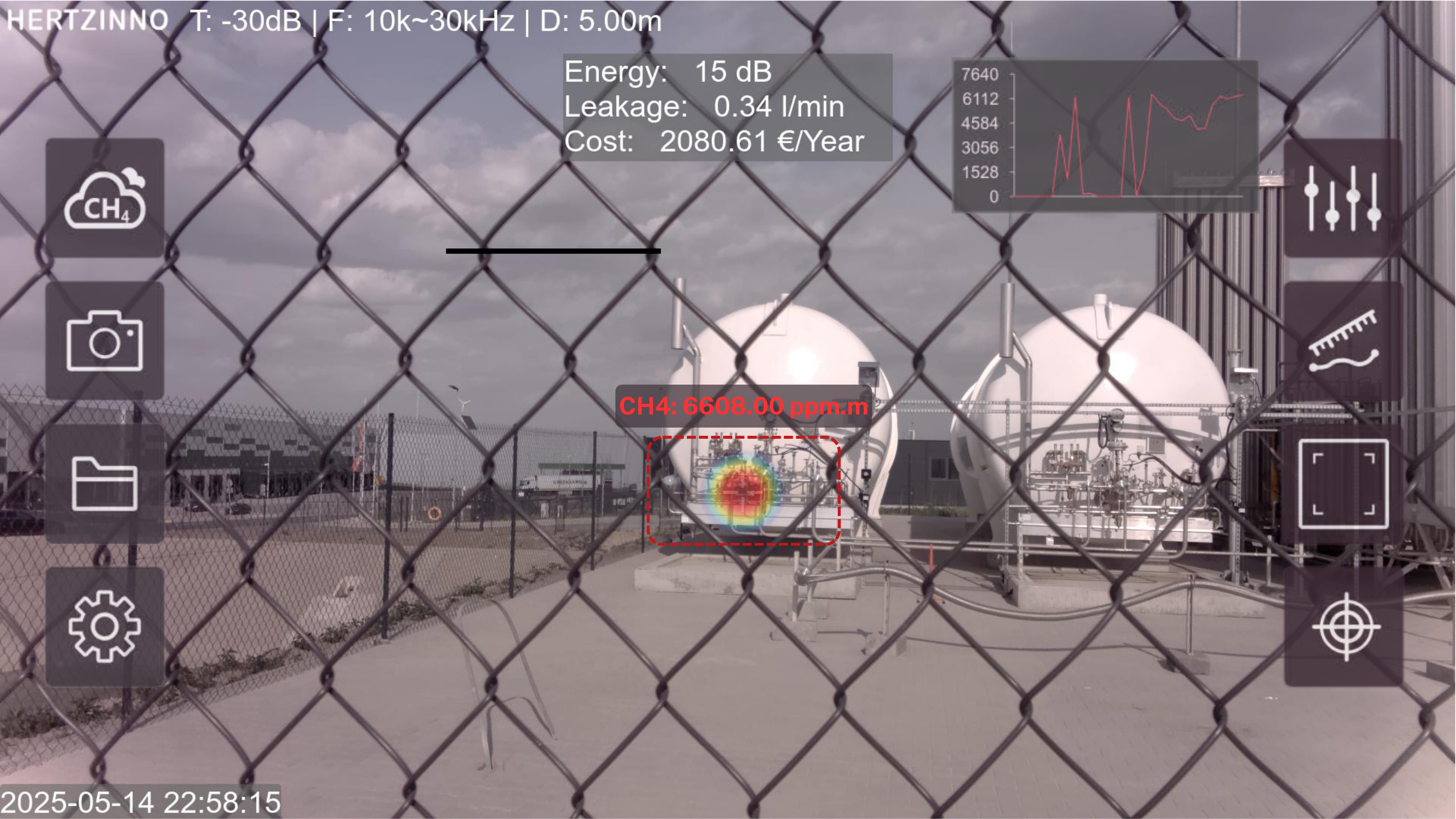
An acoustic camera can locate the leak sound source, but acoustic detection itself does not identify the gas type or directly calculate methane concentration. It detects the ultrasonic signal generated by pressurized gas leakage.
TDLAS provides a different value: methane identification and methane concentration measurement.
TDLAS, or Tunable Diode Laser Absorption Spectroscopy, detects methane based on its absorption characteristics and can calculate methane concentration. For natural gas facilities, this is extremely important.
In many real applications, field teams do not only need to know where a leak sound is coming from. They also need to know:
Whether the leaking gas is methane;
What the methane concentration level is;
Whether the location presents a safety risk;
Whether immediate action is required;
Whether methane concentration has returned to normal after repair.
This is especially important in valve stations, regulating stations, and metering stations. These sites often contain many valves, interfaces, instruments, and connection points. Simply seeing a plume or simply locating a sound source may not provide enough information for field decision-making.
This is where HA3LX creates its value.
HA3LX is designed for practical methane leak inspection in natural gas facilities and industrial methane systems. It helps users locate the leak source while also measuring methane concentration.
It combines acoustic imaging and TDLAS methane concentration measurement in one inspection workflow.
Acoustic imaging is used to quickly locate the pressurized leak source.
TDLAS is used to identify methane and calculate methane concentration.
This means inspectors can not only see where the leak sound is coming from, but also obtain methane concentration information. Compared with only seeing a plume or only locating a leak sound, HA3LX provides data that is more useful for maintenance and safety decisions.
This capability is especially valuable in valve station applications.
Valve stations usually contain many valves, flanges, regulating devices, filters, instrument ports, and pipeline connections. Leak points can be hidden, and multiple components may be located close to each other. If inspectors only see a gas plume, they may still need more time to determine which exact point is leaking.
With HA3LX, inspectors can first use acoustic imaging to locate the suspected leak hole, then use TDLAS to measure methane concentration. This allows field teams to better understand:
Where the leak point is;
Whether the leaking gas is methane;
What the methane concentration level is;
Whether the leak should be prioritized for repair;
Whether the concentration decreases or returns to normal after maintenance.
This turns methane leak detection from simply “finding an abnormality” into a more complete workflow of localization, measurement, decision-making, repair, and re-inspection.
Natural gas valve stations are one of the most typical application scenarios for methane leak detection.
On one hand, valve stations contain dense equipment and many connection points. Valve packing, flanges, threaded fittings, instrument ports, vent pipes, regulating devices, and filters can all become potential methane leak sources.
On the other hand, valve stations usually require regular inspection and documentation. Inspectors need not only to detect leaks, but also to locate the leak source, assess the risk, and provide evidence for maintenance.
In this scenario, HA3LX provides value in three main ways.
First, it helps locate the leak hole quickly.
Acoustic imaging helps inspectors find the sound source of a pressurized leak within complex equipment. Compared with applying leak detection liquid point by point or inspecting each component at close range, acoustic imaging is more efficient for rapid scanning and is useful for areas that are difficult or unsafe to approach.
Second, it measures methane concentration.
With TDLAS, HA3LX can measure methane concentration around the suspected leak area. This means the inspection result is supported not only by location information, but also by concentration data. For valve station safety management, concentration information helps teams assess risk level and maintenance priority.
Third, it supports maintenance closure.
After the repair is completed, the same point can be inspected again. Inspectors can check whether the leak sound source has disappeared and whether methane concentration has returned to normal. This is useful for creating inspection records, repair records, and re-inspection records.
OGI, acoustic cameras, and TDLAS should not be viewed simply as replacing one another. They are suited for different application scenarios.
If the main goal is to visualize gas plumes and document methane emissions, OGI is more suitable.
If the main goal is to locate the source of a pressurized leak, an acoustic camera is more suitable.
If the main goal is to identify methane and measure methane concentration, TDLAS is more suitable.
If the site requires both leak-hole localization and methane concentration data, HA3LX is more suitable for this type of application.
In simple terms:
OGI answers:
“Where is the methane plume?”
An acoustic camera answers:
“Where is the leak hole?”
TDLAS answers:
“Is it methane, and what is the concentration?”
The value of HA3LX is that it focuses on the two questions that are highly relevant to field maintenance and safety decisions:
“Where is the leak hole?”
“What is the methane concentration?”
HA3LX is suitable for a wide range of methane leak detection scenarios, especially point inspection and concentration measurement in pressurized natural gas systems.
Typical applications include:
Natural gas valve stations
Natural gas regulating stations
Natural gas metering stations
City gas network facilities
Compressor stations
Oil and gas wellheads
Gas gathering stations
LNG/CNG facilities
Industrial natural gas pipelines
Valve groups, flanges, instrument ports, and regulating equipment
In these scenarios, methane leaks often occur at specific connection components. Field teams need more than just abnormality detection. They need to locate the leak hole quickly and obtain methane concentration data.
This is where HA3LX delivers practical value.
Methane leak detection should not stop at simply seeing gas. For natural gas facilities and industrial methane systems, the more important task is to locate the leak source, measure methane concentration, and complete maintenance verification.
OGI is valuable for visualizing methane plumes.
Acoustic imaging is valuable for locating pressurized leak sources.
TDLAS is valuable for identifying methane and calculating methane concentration.
The value of HA3LX is that it brings leak-hole localization and methane concentration measurement into the same field inspection workflow.
For valve stations, regulating stations, metering stations, compressor stations, LNG/CNG facilities, and city gas infrastructure, HA3LX helps inspectors locate leak points faster, understand methane concentration more clearly, and complete repair and re-inspection more efficiently.
In methane leak detection, seeing the gas is important.
Finding the leak hole is more important.
Measuring methane concentration makes field decisions truly evidence-based.
Further reading:
[Why Acoustic Cameras Can Detect Gas Leaks]


